Problem Restated (Very Simply)
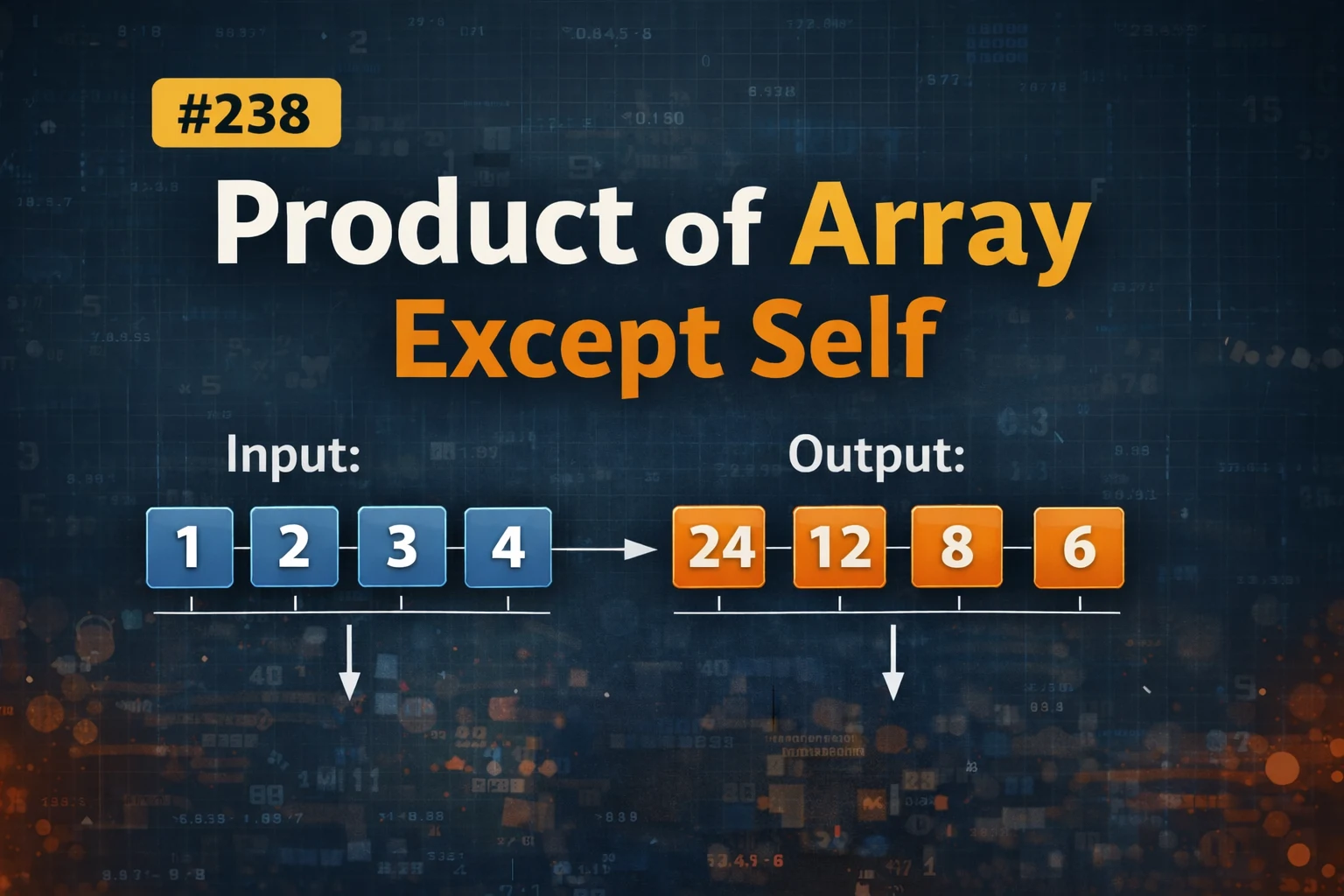
You are given an array:
nums = [1, 2, 3, 4]
For each index, you need to calculate:
Product of all elements except the one at that index
So:
- Index 0 → product of
[2,3,4] - Index 1 → product of
[1,3,4] - Index 2 → product of
[1,2,4] - Index 3 → product of
[1,2,3]
Final output:
[24, 12, 8, 6]
Why Not Just Multiply Everything?
Many beginners think:
“Why not calculate total product and divide by nums[i]?”
Two problems:
- Division is not allowed
- Zero breaks everything
So we need another way.
Core Idea (Absolute Beginner Explanation)
For any index i, the result is:
(product of numbers to the LEFT of i)
×
(product of numbers to the RIGHT of i)
That’s it.
No tricks. No division.
Step 1: Prefix Product (Left Side)
Prefix means everything before the current index.
For:
nums = [1, 2, 3, 4]
Prefix product array conceptually becomes:
Index:   0   1   2   3
Prefix:  1   1   2   6
Why?
- Index 0 → nothing on the left →
1 - Index 1 →
1 - Index 2 →
1 * 2 = 2 - Index 3 →
1 * 2 * 3 = 6
Step 2: Suffix Product (Right Side)
Suffix means everything after the current index.
Index: 0 1 2 3
Suffix: 24 12 4 1
Why?
- Index 3 → nothing on the right →
1 - Index 2 →
4 - Index 1 →
3 * 4 = 12 - Index 0 →
2 * 3 * 4 = 24
Step 3: Multiply Prefix × Suffix
Index:   0   1   2   3
Prefix:  1   1   2   6
Suffix: 24 12 4 1
Result: 24 12 8 6
This gives the answer 🎯
Two-Array Approach (Easy to Understand)
How It Works
- Build
prefix[] - Build
suffix[] - Multiply both
Code Idea (Conceptual)
answer[i] = prefix[i] * suffix[i]
Complexity
- Time:
O(n) - Space:
O(n)❌ (extra arrays)
This approach is great for beginners, but not optimal.
Optimized Approach (Interview Expected)
Instead of two arrays:
- Use one result array
- Use two variables:
prefixandsuffix
Why This Works
- First pass stores prefix directly in result
- Second pass multiplies suffix into result
- No extra arrays needed
Dry Run of Optimized Code (Very Important)
Input
nums = [1, 2, 3, 4]
Initial State
result = [1, 1, 1, 1]
prefix = 1
First Loop (Prefix Pass)
| i | result[i] | prefix |
|---|---|---|
| 0 | 1 | 1×1=1 |
| 1 | 1 | 1×2=2 |
| 2 | 2 | 2×3=6 |
| 3 | 6 | 6×4=24 |
After loop:
result = [1, 1, 2, 6]
Second Loop (Suffix Pass)
suffix = 1
| i | result[i] | suffix |
|---|---|---|
| 3 | 6×1=6 | 1×4=4 |
| 2 | 2×4=8 | 4×3=12 |
| 1 | 1×12=12 | 12×2=24 |
| 0 | 1×24=24 | 24×1=24 |
Final result:
[24, 12, 8, 6]
Optimized C++ Code (Clean & Interview-Ready)
class Solution {
public:
    vector<int> productExceptSelf(vector<int>& nums) {
        int n = nums.size();
        vector<int> ans(n, 1);

        int prefix = 1;
        for (int i = 0; i < n; i++) {
            ans[i] = prefix;
            prefix *= nums[i];
        }

        int suffix = 1;
        for (int i = n - 1; i >= 0; i--) {
            ans[i] *= suffix;
            suffix *= nums[i];
        }

        return ans;
    }
};Python
class Solution:
    def productExceptSelf(self, nums):
        n = len(nums)
        result = [1] * n

        prefix = 1
        for i in range(n):
            result[i] = prefix
            prefix *= nums[i]

        suffix = 1
        for i in range(n - 1, -1, -1):
            result[i] *= suffix
            suffix *= nums[i]

        return result
Java
class Solution {
    public int[] productExceptSelf(int[] nums) {
        int n = nums.length;
        int[] result = new int[n];

        int prefix = 1;
        for (int i = 0; i < n; i++) {
            result[i] = prefix;
            prefix *= nums[i];
        }

        int suffix = 1;
        for (int i = n - 1; i >= 0; i--) {
            result[i] *= suffix;
            suffix *= nums[i];
        }

        return result;
    }
}
JavaScript
var productExceptSelf = function(nums) {
    const n = nums.length;
    const result = new Array(n).fill(1);

    let prefix = 1;
    for (let i = 0; i < n; i++) {
        result[i] = prefix;
        prefix *= nums[i];
    }

    let suffix = 1;
    for (let i = n - 1; i >= 0; i--) {
        result[i] *= suffix;
        suffix *= nums[i];
    }

    return result;
};
Comparison Summary
| Approach | Time | Space | Interview |
|---|---|---|---|
| Brute Force | O(n²) | O(1) | ❌ |
| Two Arrays | O(n) | O(n) | ⚠️ |
| Optimized Prefix-Suffix | O(n) | O(1) | ✅ |
Common Beginner Mistakes
- Forgetting that output array doesn’t count as extra space
- Initializing prefix/suffix with
0instead of1 - Trying to use division
- Panicking when zeros appear (this solution handles them)
How to Explain This in an Interview
“For each index, the result is the product of elements before and after it.
I compute prefix products in one pass, suffix products in another, and combine them in the output array to keep space O(1).”
That answer alone impresses interviewers.
Final Takeaway
- This problem is about thinking, not memorization
- Prefix-suffix is a core array technique
- Once you get this, many other problems become easier
If you understand this solution deeply, you’re already thinking like an interview-ready engineer 👏