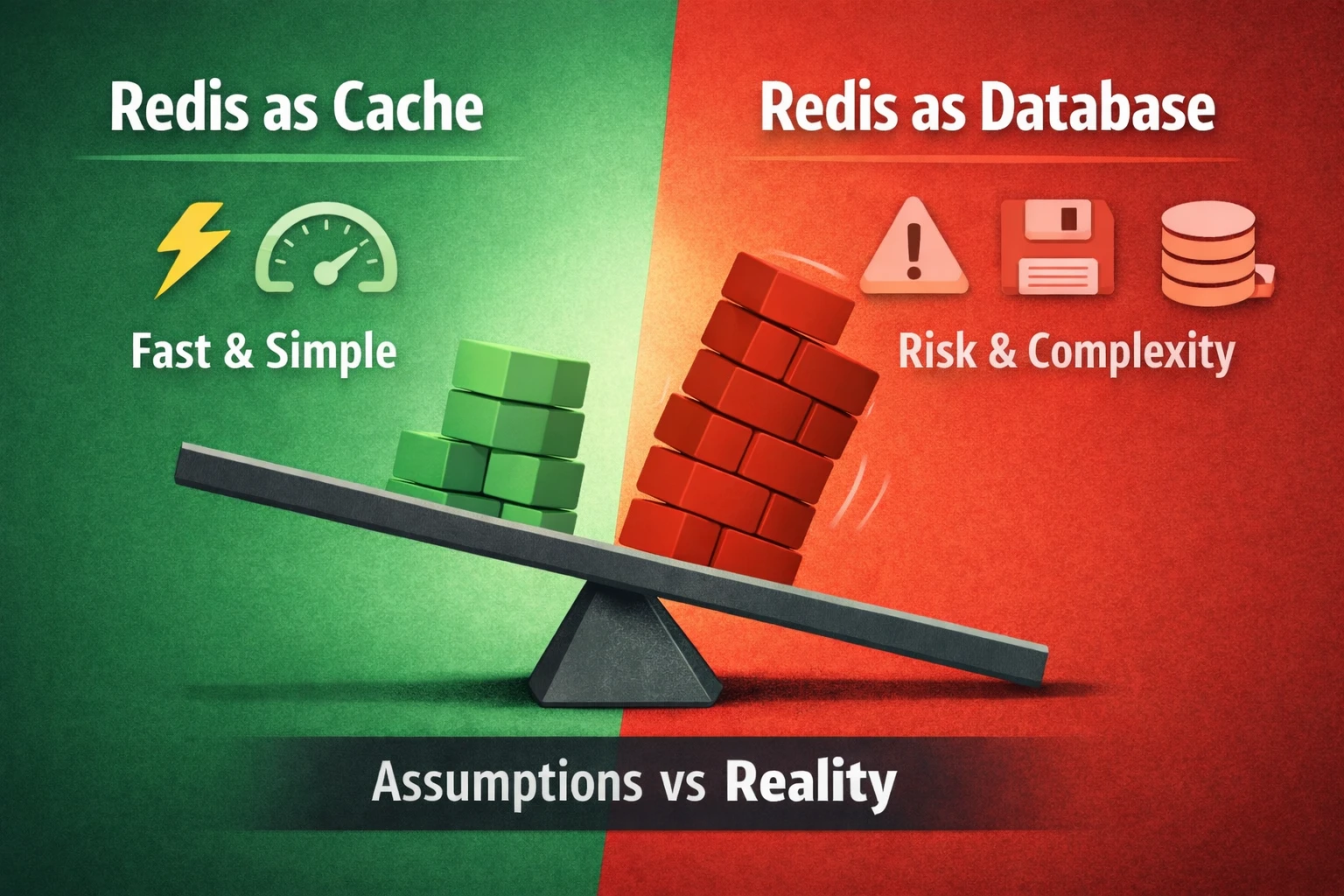
Redis has an identity problem—and most teams make it worse.
On paper, Redis is simple: an in-memory data store with optional persistence.
In practice, Redis often becomes the most critical component in the system.
Not because anyone planned it that way.
But because Redis works too well.
This article is about that slow, dangerous transition—from “just a cache” to “accidental database”—and what senior engineers must do when Redis quietly becomes part of the system’s core state.
I’ve seen Redis used correctly, incorrectly, and irresponsibly in production. I’ve also seen outages where Redis wasn’t the root cause—but exposed every bad assumption the system was built on.
Let’s talk about what Redis actually is, what it is not, and what changes the moment you depend on it.
The Lie We Tell Ourselves: “Redis Is Just Temporary”
Most Redis stories start the same way.
- Cache database queries
- Store user sessions
- Rate limit APIs
- Keep counters
- Share small state across services
All perfectly valid.
Then something subtle happens:
- Redis latency is lower than the database
- Redis logic is simpler than ORM logic
- Redis scaling is easier than DB scaling
So the system leans on it more.
Eventually:
- Writes go to Redis first
- Database writes become async
- Redis failures cause real outages
- Data loss becomes unacceptable
Redis didn’t change.
Your expectations did.
Redis Is Optimized for Speed, Not Safety
This is the part many engineers intellectually understand—but emotionally ignore.
Redis is:
- In-memory
- Single-threaded per instance
- Optimized for microsecond latency
Redis is not, by default:
- Crash-safe
- Durable under all failure modes
- Strictly consistent across replicas
- Designed for complex relational invariants
PostgreSQL assumes disks fail.
Redis assumes you know when data can be lost.
That assumption is the root of most production failures.
Persistence: Redis Will Not Save You Automatically
Redis persistence is optional and configurable—which means it’s also easy to misconfigure.
RDB Snapshots: The False Sense of Safety
RDB persistence takes snapshots at intervals.
What this means in real life:
- If Redis crashes, you lose everything since the last snapshot
- Snapshot timing depends on write frequency
- A quiet system might snapshot rarely
This is fine for:
- Cache
- Recomputed data
- Idempotent state
This is not fine for:
- Orders
- Payments
- Reservations
- User state
RDB is fast—but it’s lossy by design.
AOF: Better, But Not a Silver Bullet
Append-Only Files log write operations.
Advantages:
- Less data loss
- Better crash recovery
Trade-offs:
- Slower writes
- Larger disk usage
- Rewrite complexity
- Still vulnerable to filesystem issues
AOF improves durability—but it does not magically turn Redis into a relational database.
The Reality: Persistence Needs Testing, Not Hope
Most teams enable AOF and move on.
Few teams:
- Kill Redis mid-write
- Fill the disk intentionally
- Restart during AOF rewrite
- Validate restore correctness
- Monitor persistence latency
Databases are trusted because they are boring and over-tested.
Redis requires discipline, not blind confidence.
Redis as a Single Source of Truth: A Dangerous Promotion
The moment Redis becomes the only place data exists, the system’s risk profile changes completely.
At that point, Redis is:
- A database
- A coordination engine
- A business logic gatekeeper
But unlike databases, Redis:
- Won’t enforce schema
- Won’t enforce relationships
- Won’t protect invariants unless you do
This is where systems fail silently.
Atomicity: Redis Is Atomic, Your Logic Is Not
Redis guarantees atomic execution of commands.
That does not mean your business rules are safe.
Example failure patterns:
- Multiple keys updated separately
- Partial updates on network failure
- Retries causing double writes
- Read-modify-write race conditions
Engineers often assume:
“Redis is single-threaded, so it’s safe.”
That assumption only holds for single commands.
The moment logic spans:
- Multiple keys
- Multiple commands
- Multiple services
You need stronger guarantees.
Lua Scripts Are Not Optional at Scale
Lua scripting is how Redis enforces invariants.
If your system depends on:
- Inventory not going below zero
- A user not double-booking
- Rate limits not being bypassed
- Idempotency under retries
Then Lua is not an optimization—it’s mandatory.
Skipping Lua is how systems behave correctly in staging and fail under load.
TTLs: The Most Abused Redis Feature
TTL-based data expiration is one of Redis’s best features—and one of the most dangerous.
Common mistakes:
- TTL on critical state
- TTL used as business logic
- TTL assumed to be precise
- TTL expiry treated as guaranteed cleanup
Reality:
- TTL expiration is lazy
- Keys may live longer than expected
- Memory pressure may evict keys early
- Expiry is not transactional
If losing a key breaks your system, it should not have a TTL.
Memory Pressure: Redis Will Evict Without Mercy
Redis is honest about memory limits.
When memory is full:
- Keys are evicted
- Writes may fail
- Performance degrades
- State disappears
Redis does not ask whether data is important.
If your eviction policy is wrong—or memory usage spikes unexpectedly—Redis will delete data faster than any bug.
Databases fail loudly.
Redis fails efficiently.
Replication and High Availability: More Subtle Than It Looks
Redis replication is asynchronous.
That means:
- Replicas can lag
- Failover can lose recent writes
- Reads from replicas may be stale
In practice:
- HA Redis setups still lose data
- Failover correctness depends on timing
- Client libraries matter more than people think
Redis Sentinel and Redis Cluster help—but they don’t remove fundamental trade-offs.
If your system assumes “replica equals safety,” it’s already broken.
Redis in Distributed Systems: Where Things Get Serious
Redis is often used for:
- Distributed locks
- Leader election
- Coordination
- Queues
- Rate limiting across nodes
These are powerful patterns—and also failure magnets.
Locks expire.
Networks partition.
Clients retry.
Time drifts.
If you use Redis for coordination, you must design for:
- Clock skew
- Partial failure
- Duplicate execution
- Lost unlocks
Distributed systems don’t forgive optimism.
Security Is Not Just About Hackers
Most Redis failures are self-inflicted.
Common incidents:
- Unauthenticated Redis exposed internally
- Accidental
FLUSHALL - Shared Redis across environments
- Debug commands in production
- Poor ACL discipline
Security is protecting data from:
- Bugs
- Operators
- Automation
- Assumptions
Redis gives you the rope.
Production experience teaches you how not to hang yourself with it.
When Redis Actually Works as a Database
Redis can behave like a database—but only if you force it to.
That means:
- Persistence enabled and tested
- Lua scripts for invariants
- No TTL on critical data
- Backups verified
- Memory limits planned
- Eviction policy intentional
- Monitoring in place
- Restore procedures rehearsed
At that point, Redis stops being “easy” and becomes engineered.
That effort is justified in some systems:
- Real-time trading
- High-frequency counters
- Reservation systems
- Online gaming state
- Streaming coordination
It is not justified everywhere.
Small Systems vs Large Systems: The Honest Comparison
Small Systems
- Redis is a cache
- Database is authoritative
- Redis loss is acceptable
This is the safest, most maintainable design.
Large Systems
- Redis sits in the critical path
- Database is async or secondary
- Redis failure causes outages
At this level, Redis must be treated as infrastructure—not a convenience.
The mistake is building a large-system dependency with a small-system mindset.
The Mental Model That Prevents Regret
Ask one question—early and often:
If Redis disappears right now, does the system recover automatically?
If the answer is yes:
- Redis is a cache
- You’re safe
If the answer is no:
- Redis is a database
- Whether you admit it or not
From that point on, pretending otherwise is negligence.
Final Thoughts: Redis Is Honest—Engineers Often Aren’t
Redis never promised to be a database.
It promised:
- Speed
- Simplicity
- Control
Everything else is your responsibility.
Redis doesn’t corrupt data.
Redis doesn’t hide failures.
Redis doesn’t lie.
It does exactly what you configure it to do.
If Redis causes an outage, the real failure happened earlier—when the system was designed.
Treat Redis lightly, and it will fail quietly.
Treat it seriously, and it will outperform systems ten times its complexity.
The tool isn’t the problem.
The assumptions always are.