Every generation of developers gets a new superpower.
At one point, it was frameworks.
Then cloud.
Then CI/CD.
Now it’s AI-assisted coding, often wrapped in a trendy phrase: vibe coding.
You prompt an AI, stay in flow, generate large chunks of code quickly, and feel productive. Features appear fast. Demos look great. You ship sooner than you ever could before.
And then reality arrives.
Production traffic.
Real users.
Security concerns.
Edge cases no one thought about.
This is where engineering judgment separates itself from pure speed.
This article isn’t anti–vibe coding. I use AI every day. But after building and maintaining real systems, handling incidents, and debugging failures that cost time and trust, one lesson keeps repeating itself:
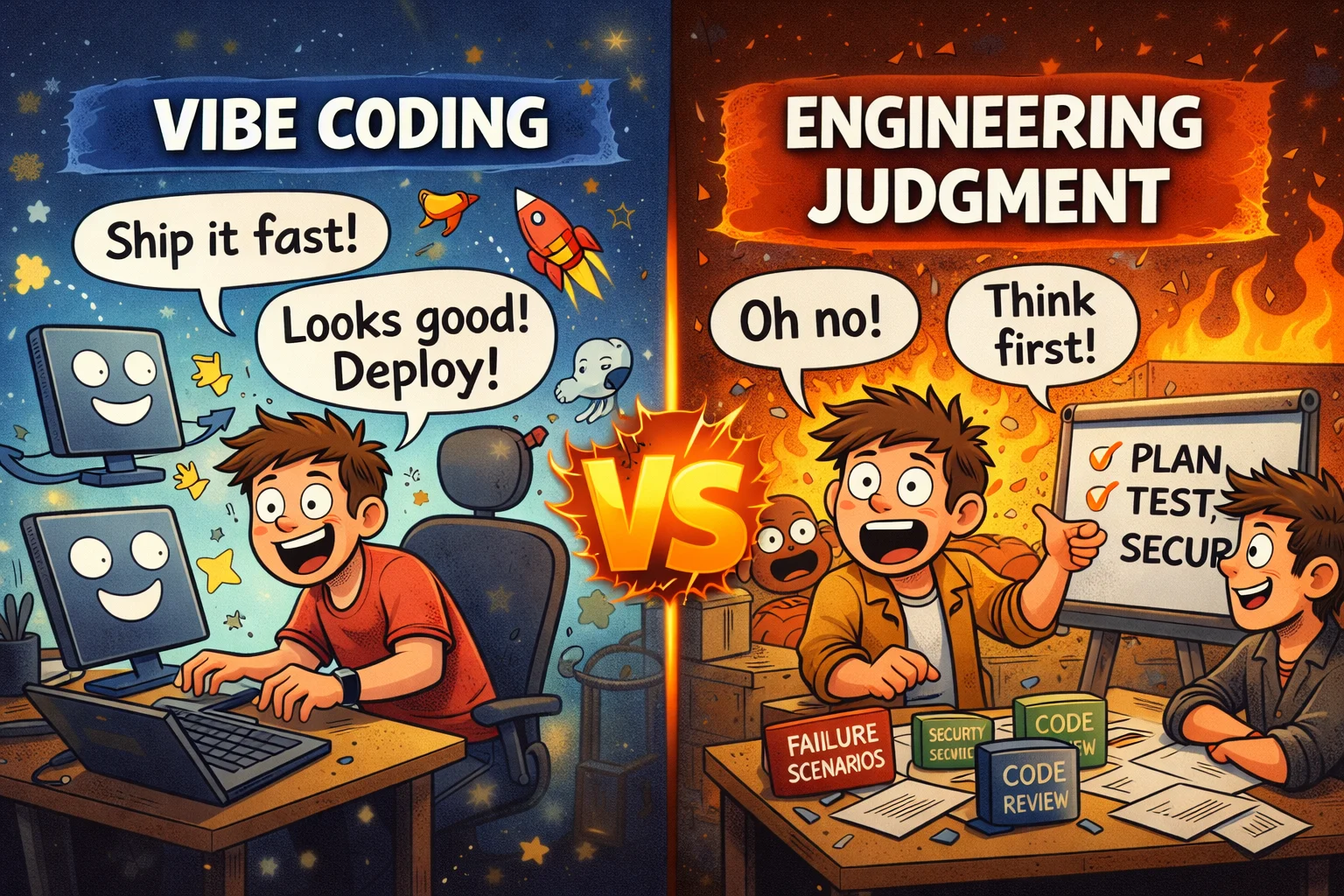
Vibe coding accelerates output. Engineering judgment determines whether that output survives.
What Vibe Coding Really Is (Beyond the Buzzword)
Vibe coding isn’t a tool. It’s a mindset.
It usually looks like:
- minimal upfront design,
- heavy reliance on AI-generated code,
- trusting “good-looking” solutions,
- prioritizing momentum over scrutiny.
The goal isn’t correctness.
The goal is flow.
And flow feels amazing.
You’re not stuck on syntax. You’re not googling boilerplate. You’re not context switching. You’re just building.
For certain problems, that’s a legitimate advantage.
Why Vibe Coding Feels So Effective
Vibe coding works because it removes friction at exactly the points developers dislike most.
1. It Eliminates the Blank Page
AI gives you something to react to immediately. That alone can double productivity for early-stage work.
2. It Compresses Feedback Loops
You see results instantly. The faster the feedback, the stronger the sense of progress.
3. It Offloads Cognitive Load
You don’t have to remember syntax, patterns, or library quirks. The AI fills those gaps.
For small, low-risk scopes, this is pure upside.
The problem is that software risk does not scale linearly with code size.
Engineering Judgment: The Invisible Skill
Engineering judgment is harder to define because it’s not about typing code.
It’s about decisions.
Decisions like:
- where to put boundaries,
- what assumptions are safe,
- how systems fail,
- what happens under retries,
- which shortcuts are acceptable,
- which shortcuts are dangerous.
Engineering judgment is built from:
- past mistakes,
- production outages,
- security reviews,
- failed deployments,
- systems that aged badly.
AI does not carry those scars. Humans do.
The Core Difference in One Sentence
- Vibe coding asks: “Does this work?”
- Engineering judgment asks: “What happens when this breaks?”
That difference changes everything.
Where Vibe Coding Works Extremely Well ✅
Let’s be fair. There are places where vibe coding is exactly the right tool.
1. Disposable Prototypes
If the code is meant to be thrown away:
- proof-of-concepts,
- demos,
- internal experiments,
- UI mockups,
then vibe coding is ideal.
Longevity doesn’t matter. Architecture doesn’t matter. Risk is low.
Speed is the entire point.
2. Hackathons and Learning Projects
When you’re exploring:
- a new API,
- a new framework,
- an idea you’re not sure about,
vibe coding lets you explore without friction.
You’re optimizing for learning, not durability.
3. Boilerplate and Repetition
AI excels at:
- CRUD APIs,
- form handling,
- DTO mapping,
- config setup,
- test scaffolding.
This is time you don’t need to spend manually.
Using AI here is not reckless. It’s efficient.
Where Vibe Coding Quietly Fails ❌
This is where experience starts to matter.
1. Long-Lived Production Systems
Any system that:
- will be maintained for years,
- will be touched by multiple teams,
- will evolve under changing requirements,
is a bad place for unchecked vibe coding.
Why?
Because AI-generated code often:
- encodes assumptions that age poorly,
- over-abstracts early,
- hides complexity instead of managing it.
The cost isn’t immediate. It shows up months later.
2. Security-Critical Code
Authentication.
Authorization.
Payments.
Secrets.
Vibe coding here is dangerous because:
- insecure defaults often look “reasonable,”
- vulnerabilities don’t break functionality,
- failures are silent until exploited.
AI does not threat-model.
Engineering judgment does.
3. Complex Business Logic
Business rules are messy:
- exceptions override rules,
- policies change mid-flight,
- edge cases are politically sensitive.
AI tends to:
- simplify logic incorrectly,
- flatten nuance,
- encode rules that were never actually true.
Judgment is knowing which rules matter when systems are stressed.
A Real Production Mistake I Made Using Vibe Coding
Here’s a real example.
I used AI to quickly implement a background job pipeline for an internal service. The code was clean. Retries were implemented. Logging existed. Tests passed.
Everything worked in staging.
What I didn’t catch:
- retries weren’t idempotent,
- partial failures caused duplicate writes,
- the logs didn’t expose the real failure path.
The system slowly corrupted data under rare conditions.
It took a production incident to reveal it.
The AI didn’t fail.
My judgment did.
I trusted output over understanding.
The Illusion of “Looks Correct”
One of the most dangerous things about AI-generated code is how reasonable it looks.
- naming is good,
- structure is clean,
- patterns feel familiar.
That aesthetic correctness tricks engineers into skipping deeper review.
Engineering judgment means distrusting code that looks too easy.
How Much Vibe Coding Is Too Much?
Here’s a rule that works in practice:
If you can’t explain how the code fails, you don’t understand it well enough to ship it.
AI can help write code.
Only humans can take responsibility for failure.
Healthy boundaries look like:
- AI writes the first draft,
- humans review assumptions,
- humans own security and correctness,
- humans decide what ships.
AI is an assistant, not an engineer of record.
Security Risks Are the Quietest Failures
The most dangerous problems caused by vibe coding don’t crash systems.
They leak data.
They bypass checks.
They allow misuse.
Common examples:
- permissive auth logic,
- missing rate limits,
- unsafe defaults,
- dependency choices without vetting.
Everything “works” until it doesn’t.
Security requires paranoia. AI doesn’t have that instinct.
Engineering Judgment Shows Up at Boundaries
Senior engineers slow down at boundaries:
- API edges,
- persistence layers,
- integrations,
- user input,
- background jobs.
These are the places where small mistakes have large consequences.
Vibe coding speeds through boundaries.
Judgment slows at them.
Debugging Reveals the Difference
When something breaks in production:
- AI doesn’t get paged,
- AI doesn’t read logs,
- AI doesn’t own the outcome.
The engineer does.
Code written without judgment is harder to debug because:
- assumptions are implicit,
- failure modes are unconsidered,
- observability is shallow.
Judgment is writing code you can reason about at 2 AM.
Why AI Makes Judgment More Valuable, Not Less
This is the part many people miss.
AI doesn’t reduce the need for engineers.
It raises the bar for what engineering means.
When writing code is cheap:
- deciding what to write becomes expensive,
- deciding what not to write becomes critical.
Judgment becomes the differentiator.
Vibe Coding Is Not a Skill Replacement
Vibe coding amplifies skill. It doesn’t replace it.
A junior engineer with AI writes bad code faster.
A senior engineer with AI writes good code faster.
The difference isn’t the tool.
It’s experience.
A Practical Mental Model
Use this mental split:
- Low-risk, throwaway code → vibe coding
- High-risk, long-lived code → judgment-first
If the cost of failure is high, slow down.
The Balanced Reality
The future is not:
- “AI writes everything”
- “AI replaces engineers”
The future is:
- AI accelerates implementation,
- humans retain responsibility,
- judgment becomes the core engineering skill.
Final Verdict
Vibe coding is powerful.
Engineering judgment is non-negotiable.
Use vibe coding to:
- explore ideas,
- reduce friction,
- move fast where risk is low.
Rely on engineering judgment to:
- protect users,
- secure systems,
- design for failure,
- own production outcomes.
Speed ships features. Judgment keeps systems alive.
That’s not philosophy.
That’s what production teaches you